

When it comes to workplace safety, understanding the difference between fall restraint and fall arrest is essential. Although both systems protect workers at height, they serve different purposes.
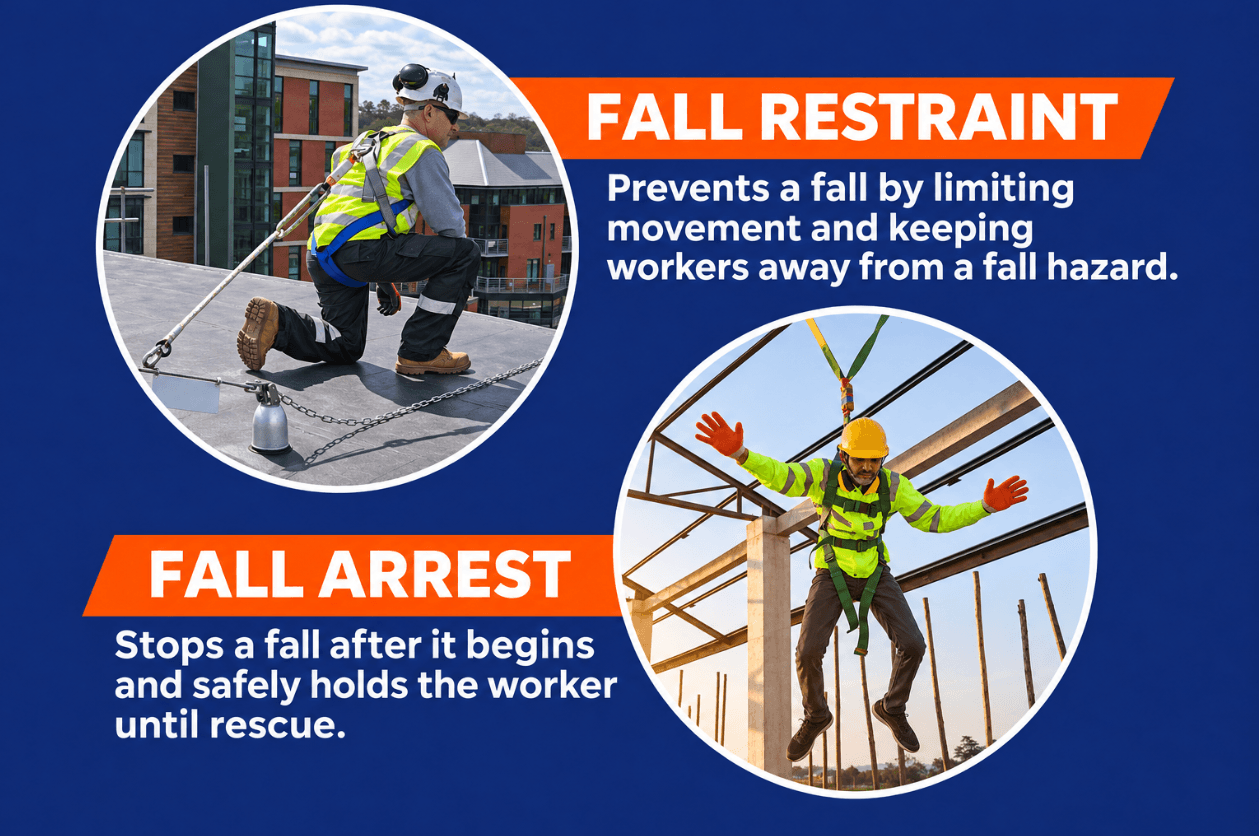
Fall restraint prevents a fall from occurring, while fall arrest stops a fall after it begins.
Choosing the right approach depends on the work environment, potential hazards, and the level of mobility workers need.
What Is Fall Restraint?
A fall restraint system prevents workers from reaching an unprotected edge or other fall hazard. By limiting how far someone can travel, a properly configured system keeps workers within a designated safe work area.
For example, a worker performing rooftop maintenance may use a restraint system that allows access to equipment while preventing movement too close to the roof’s edge.
Whenever practical, fall restraint should be considered before fall arrest because preventing a fall is generally safer than stopping one.
What Is Fall Arrest?
A fall arrest system allows workers to access areas where fall hazards exist while providing protection if a fall occurs.
These systems typically include a full-body harness, engineered anchorage, and a connecting device such as a self-retracting lifeline (SRL).
Fall arrest is commonly used in industrial environments where workers must access elevated machinery, trucks, railcars, or maintenance platforms.
Unlike fall restraint, fall arrest requires careful consideration of fall clearance, anchorage loads, and rescue procedures.
Fall Restraint vs Fall Arrest: Key Differences
| Fall Restraint | Fall Arrest |
| Prevents a fall from occurring | Stops a fall after it begins |
| Restricts access to fall hazards | Allows work where fall hazards exist |
| No fall-arrest clearance needed when properly configured | Requires sufficient fall clearance |
| Avoids post-fall suspension | Requires prompt rescue capability |
| Ideal for controlled work areas | Ideal when exposure to fall hazards is unavoidable |
Why Rescue Planning Matters
One of the most important considerations when selecting fall arrest is what happens after a fall.
Although a fall arrest system stops the worker from striking a lower level, the worker may remain suspended in a harness until rescued.
Prolonged suspension can lead to serious medical complications.
Fall protection doesn’t end when the fall stops. It ends when the worker is safely rescued.
This is one reason fall restraint is generally preferred whenever the work can be performed without exposure to a fall hazard.
What Does OSHA Require for Fall Restraint and Fall Arrest?
Federal OSHA recognizes both fall restraint and fall arrest as methods of protecting workers at height. Fall restraint systems must prevent workers from reaching a fall hazard, while fall arrest systems must meet specific requirements for anchorage strength, stopping distance, and impact forces.
In California, Cal/OSHA establishes fall protection requirements under Title 8. Section 1670 addresses personal fall restraint and fall arrest systems in construction, while Section 3210 addresses guardrails at elevated locations in general industry, including certain exceptions allowing fall restraint or fall arrest systems. Specific requirements depend on the industry and work being performed.
Both federal OSHA and Cal/OSHA require employers to provide for prompt rescue following a fall.
Choosing the Right Fall Protection System
Industrial facilities often require engineered solutions that balance worker safety with the ability to move freely throughout a work area.
Overhead fall protection systems, including rigid rail systems and horizontal lifelines, can provide continuous protection across loading docks, manufacturing facilities, and maintenance operations.
Depending on their design, these systems may be configured for fall restraint or fall arrest. When evaluating a system, important considerations include worker mobility, available fall clearance, structural capacity, and rescue requirements.
Find the Right Fall Protection Solution with CH Bull
CH Bull provides engineered fall protection solutions for industrial environments, including rigid rail systems, horizontal lifelines, and rooftop protection systems.
Whether your facility needs fall restraint or fall arrest, our team can help identify a solution based on your work environment and safety requirements.